Skip to main content Skip to textbook navigation Skip to book list Skip to sitemap Skip to the student site Skip to the instructor site Skip to bvt lab

Scroll to top

Home

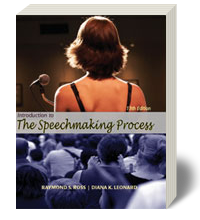
Introduction to the Speechmaking Process

Cover for Introduction to the Speechmaking Process 13

Introduction to the Speechmaking Process

Thirteenth Edition   Leonard, Ross, © 2009, 474 pages

Relevant theory and pragmatic student needs have guided the content decisions for most of Introduction to the Speechmaking Process. This new edition also recognizes the importance and influence of technology and therefore integrates its understanding and use throughout the book.

Request Examination Copy

Popular Formats (with student pricing)

Traditional Print
Traditional Print
...with
LAB BOOKPlus
$27
keyboard_arrow_down keyboard_arrow_up

Traditional Print

Our traditional print version of this textbook is available in the following formats:

  • Loose-leaf textbook ($27)
  • TEXTBOOKplus [Loose Leaf / online eBook / downloadable eBook / Lab] ($)

See Prices and ISBNs for bookstore pricing.

Keep reading

Prices and ISBNs

This title is available in the following formats.

Product Description
ISBN
Description ISBN Bookstore
(Net Price)
Student
(Retail Price)
Loose Leaf Unbound textbook
978-1-59602-734-3
Unbound textbook 978-1-59602-734-3 (9781596027343) $20 $27

Supplements

The available Supplements are listed below:

Click here to access ancillaries   save_alt
Instant Access (and Coupons)

All students can have free Instant Access to an eBook for the first two weeks of class while they procure their textbook. They will also receive a 10%-off coupon valid at the BVT web store for the best possible price. Get instant access codes here.

Instructor's Manual
The instructor is provided access to a downloadable Instructor's Manual which is designed to assist the instructor by providing a variety of pedagogical tools.
Test Bank
The Test Bank contains questions in a variety of formats including multiple choice, true/false, and essay questions.
Online Course Management Software
Use our online course management software to create randomly-generated tests which can be downloaded directly into your course management software, such as Blackboard, Web CT, Desire 2 Learn, and E Learning.
For your students
BVT Publishing is pleased to now introduce a website, www.bvtstudents.com, that is dedicated specifically to your students' academic success, including flashcards, chapter summaries, practice quizzes, ebooks, and direct purchase.

Excerpts

About the Authors

Diana Leonard person
Diana K. Leonard, Ph.D., is Senior Lecturer in the Department of Communication at the University of Arizona, Tucson, Arizona. Born in Tucson, she received her Bachelor of Arts in Psychology from hte University of Arizona, and her Master of Arts in Communication from San Francisco State University. Her focus was on small group communication, cultural studies, and teaching communication. She earned her Ph.D. in Higher Education Organization and Administration from The University of Arizona.

Currently, Dr. Leonard serves as the Director of Public Speaking at The University of Arizona, lecturing for the Introduction to Public Speaking and guiding Graduate Teaching Assistants through their teaching. She also teaches Advanced Public Speaking, Argumentation, Theories of Small Group Communication, and Communication and Conflict. She has taught multiple communication courses throughout her career, including Introduction to Communication; Interpersonal Communication; Communication and Human Interaction; Communication in Fiction, Film and Poetry; Communication Criticism; Communication and Instruction; as well as Introduction to Public Speaking and Introduction to Small Group Communication. Prior to joining the Department of Communication at The University of Arizona, Dr. Leonard taught at various community colleges in the Bay Area, for the Department of Speech Communication at San Francisco State University, and for Northern Arizona University’s Statewide Program.

Her role as faculty advisor for communication majors at The University of Arizona inspired Dr. Leonard toward pursuing her Ph.D. in Higher Education. Determined to understand the impact teachers have on students, she studied influences on students’ decision to transfer from a two-year institution to a four-year institution. Her dissertation is titled, “Shaping Fuzzy Goals through Teacher-Student Interaction: A Detailed Look at Communication between Community College Faculty and Transfer Students.” She is a contributing author to Public Speaking for the Curious: Why Study Public Speaking? (The Curious Academic Publishing, 2015) and coauthor of the third edition of The Pursuit of Possible Truth: A Primer on Argument (Kendall Hunt, 2020) with Dr. Michael Dues and Dr. Mary Brown.

Dr. Leonard leads communication-training seminars and also consults for private clients and organizations in decision-making processes, communication strategies, and presentation skills. In her free time, she tends to her farm animals, including chickens, goats, a horse, three dogs, a tortoise, and—of course—treasures time with her spouse, family, and friends.

Raymond Ross person
Raymond S. Ross, Ph.D. was Professor Emeritus, Department of Communication, Wayne State University, Detroit, Michigan. Born in Milwaukee, Wisconsin, Professor Ross received his Bachelor of Philosophy and Master of Arts degrees from Marquette University. He earned an interdisciplinary Ph.D. in communication and psychology from Purdue University in 1954.

Dr. Ross is best known for his several, popular college textbooks: Speech Communication, now in its 12th edition; Small Groups in Organizational Settings: Understanding Persuasion, 4th ed.; Essentials of Speech Communication, 2nd ed.; Communication and Interpersonal Relations;; and Relating and Interacting: An Introduction to Interpersonal Communication. His trade book, When Your Number's Up (2005), is a nonfiction novel about his combat experiences in World War II.

Dr. Ross is listed in American Men of Science, Directory of American Scholars, National Register of Scientific Personnel, Who's Who in the Midwest, Contemporary Authors, and Outstanding Educators of America. He was the recipient of a Distinguished Alumni Award from Marquette University and was a Distinguished Visiting Professor at Pepperdine University. He was also a member of many academic and professional organizations, including the National Communication Association and the American Psychological Association.

While at Ohio State University he was appointed Mershon Professor Air Science (AFROTC). For many years Professor Ross was an educational advisor to ROTC programs and the 10th Air Force Reserve. At WSU he was a staff member of the Institute of Industrial Relations, Wayne State University/University of Michigan, where he served as director of executive development programs. He has served as a research, training and communication consultant to numerous government, military, business and industrial firms.

Before Dr. Ross passed away in 2015, he and his wife, Ricky, live in Traverse City, Michigan. They had two sons, Mark and Scott, and a golden retriever named Buddy.


Description

As in earlier editions, relevant theory and pragmatic student needs have guided the content decision for most of Introduction to the Speechmaking Process. Its basic pedagogical assumption is that students are better served by a "theory and practice" approach than by one that is all practice (or all theory, for that matter). The theory is necessary to power and steer the practice. Likewise, this current edition remains influenced by popular interactionist and social construction views as well as by relevant behavioral/cognitive theories. Its rhetorical roots are also evident in its treatment of ethics, models, and practice. These generalizations from theory to practice, whether cast as rules or laws, have been simplified to facilitate understanding and application for the student. Speaking experience governed by theory, principle, and professional criticism should promote sound communication habits, whatever the setting. This current text, however, also recognizes the importance and influence of technology and, therefore, integrates its understanding and use throughout the book.

xs
sm
md
lg
xl
Support

Whether you are a long-term client of ours, or are adopting one of our textbooks for the first time, we are here to help. To get you started, here is a simple 7-point guide to setting up and running your online class with a BVT textbook.

Guide to Running an Online Class using BVT's LAB BOOK Platform
Step 1.   Adopt the LAB BOOK format of a BVT Textbook (see available titles). Step 2.   Put an Instant Access link in your LMS to get your students started on day-one. Step 3.   Take advantage of the built-in LAB BOOK homework assignments. Step 4.   Pick and choose from the classroom tools you want to use. Step 5.   Set up quizzes and exams if you want (with our help), or use what you already have in your LMS. Step 6.   Transfer your grades at the end of semester, or have us hook up a full LMS integration. Step 7.   Call us during office hours and speak to a live person whenever you want.